
Stories · · 4 min
The circle in the rectangle
At Narthamalai there is a geometry that cannot be seen from inside the building or outside it. It exists only in a drawing.
Vaayil · Narthamalai, Tamil Nadu
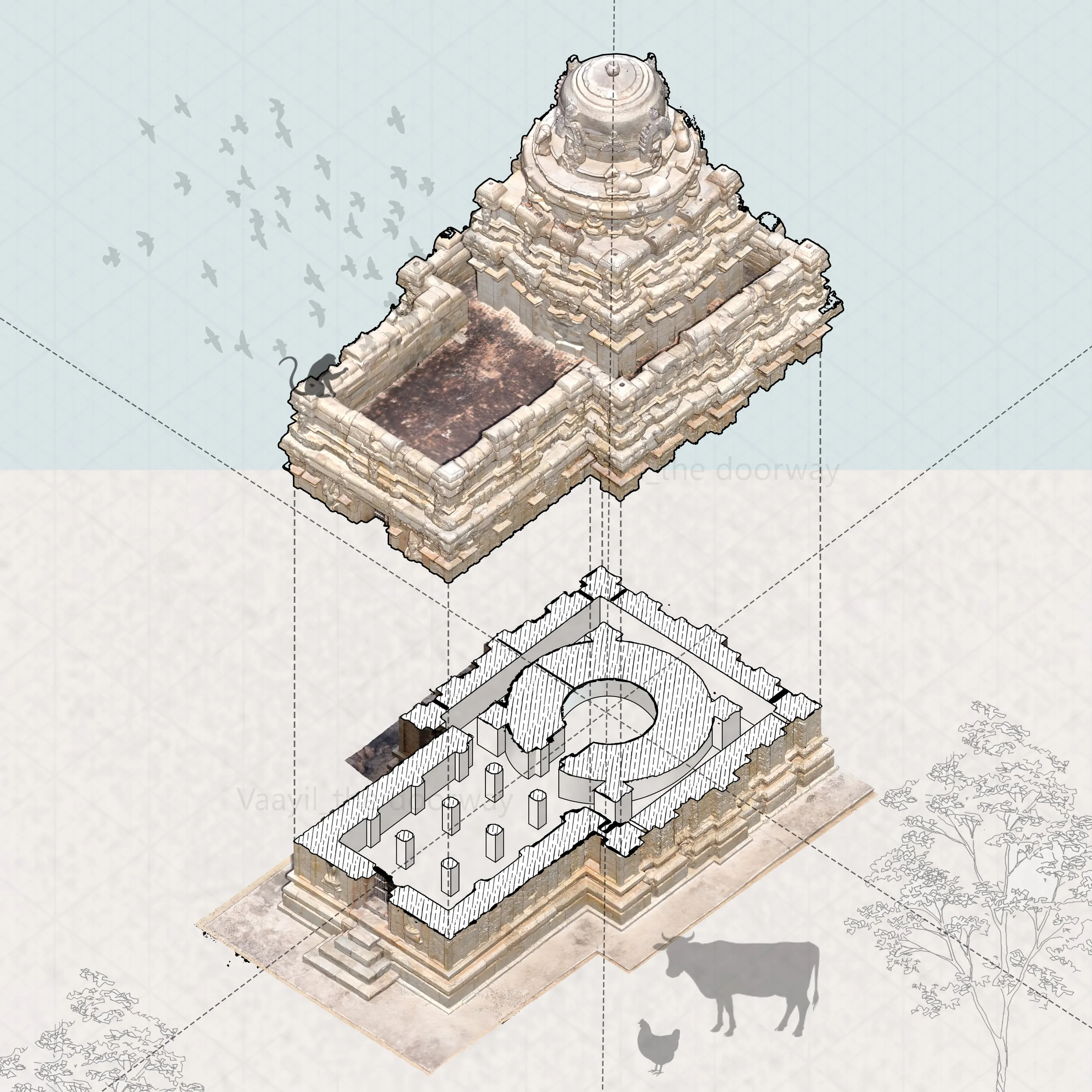
Walk up to the temple on the lower slope at Narthamalai and you will see an ordinary thing. A moulded plinth. Plain granite walls. A stepped superstructure rising to a fluted dome. It is well proportioned and it is nine hundred years older than almost anything you have stood in front of this year, but nothing about the elevation tells you that you are looking at an unusual building.
Then you read the plan.
Inside the rectangle is a circle.
The thing you cannot see
The sanctum is circular, set within the rectangular envelope and ringed by a colonnade of plain square piers. This is not a subtlety of proportion. It is a different shape inside another shape, and it is invisible.
It is invisible from outside, because the rectangular wall is in the way. It is invisible from inside, because standing in the circular chamber the rectangle is behind that same wall. There is no position, on the ground, in the air, inside or out, from which a person can see the relationship between the two.
So the relationship exists only in plan. Which is to say: it exists only in a drawing.
What a photograph would have recorded
A photograph of this temple is a photograph of a rectangular building. It is accurate. It is well lit. It records the weathering on the dome and the vegetation at the base and the exact colour of nine-hundred-year-old granite in December. And it does not contain the fact that the building is about.
This is the clearest case we have found for why documentation is not photography, and why Vaayil draws.
What the drawing does
The plate cuts the temple at plinth level and fills the cut stone with hatch, so that solid reads as solid at a glance. It lifts the superstructure clear and holds it in register with four dashed projection lines, so that the two halves are visibly one object taken apart rather than two objects placed near each other. Between them, in the space the roof used to occupy, the circular sanctum sits inside its rectangular envelope with the colonnade legible all the way round.
One of these is a picture of the temple. The other is an argument about it.
What we still do not know
The interior of the sanctum was not entered during this survey. The circular chamber is recorded from the exterior and from the exploded section only.
The date is contested. We follow the ninth-century attribution, but the association with Vijayalaya Chola is not established by any inscription on this structure, and no patron is named in any inscription we have examined at the site. The plinth mouldings, the element that carries most of the dating evidence, remain legible throughout. They may eventually settle it. They have not settled it yet.
We publish the drawing anyway, with the gaps written down beside it. That is the whole method: say what the building is, say how you know, and say where knowing stops.
The record this rests on
Vijayalaya Cholisvaram Narthamalai · Pudukkottai VAY-M-00001 · c. 9th century CE Fair