
How we work
Our method is published.
Equipment, capture, drawing convention, ethics, uncertainty and citation. An institution should be able to audit how we work before commissioning us, and a reader should be able to audit a record before quoting it. Technology should increase trust, not uncertainty.
01 · Why we document
India is not short of heritage. What it is short of is record: measured, dated, citable documentation of what those buildings actually are.
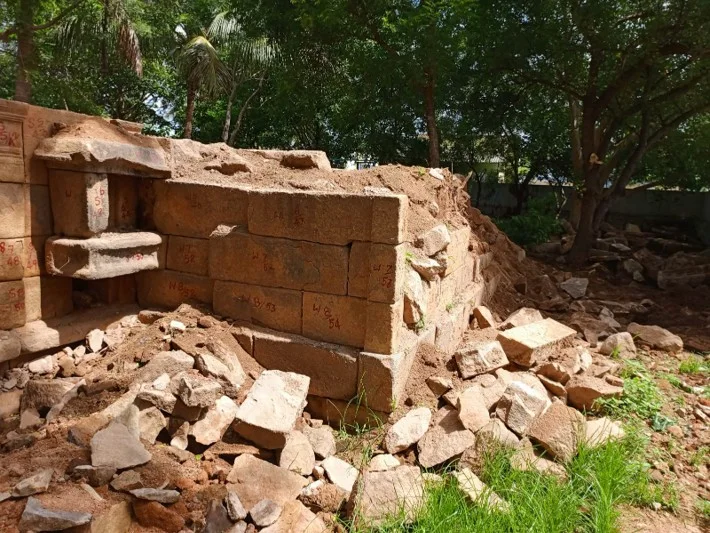
Photography is not documentation. A photograph records a viewpoint. It cannot tell you the thickness of a wall, the profile of a plinth moulding, the relationship between a sanctum and the envelope around it or how far the superstructure has moved since it was built. Those are the questions conservation asks and a photograph answers none of them.
What a record is
A Vaayil record is a single monument, surveyed on stated dates by stated methods, drawn and published with its evidence attached. It carries:
- where the building is and how precisely we are willing to say so
- when it was built and how confident that dating is
- what condition it is in, part by part and the date that assessment was made
- how the survey was performed, with what software, to what tolerance
- what we were unable to establish
The last item is not a disclaimer. It is a field of the record, it is required by the schema and a record cannot be published without it.
Why openness
A record held privately is a record that dies with the studio that made it. Vaayil publishes under a licence that permits scholarship, teaching and non-commercial reuse, with a permanent URL and a citation for every record, so that a measurement taken in 2026 is still addressable in 2056.
Documentation is the beginning, not the destination. Without it, conservation is guesswork performed at scale on objects that cannot be replaced.
The rest of the method
- 02 How a survey is made Aerial and terrestrial photogrammetry, resolved into a single measurable model of the building.
- 03 How a drawing is made The mesh is evidence. The drawing is an argument about it, made in the conventions of architecture.
- 04 What we do not know Every record states its own limits. The schema will not accept one that does not.
- 05 Ethics and access These are living buildings before they are subjects. Documentation is arranged around that, not despite it.
- 06 Citing a record Every record has a permanent identifier, a permanent URL and a version. All three are meant to be quoted.
- 07 From screen to study model Accurate documentation is the foundation. Because the survey data is metric, it can return into physical form.
Commissioning a survey
Vaayil surveys for government departments, temple trusts, universities and conservation practices. Scope, method, uncertainty and deliverables are agreed before work begins and stated in the record afterwards.